
Subjects
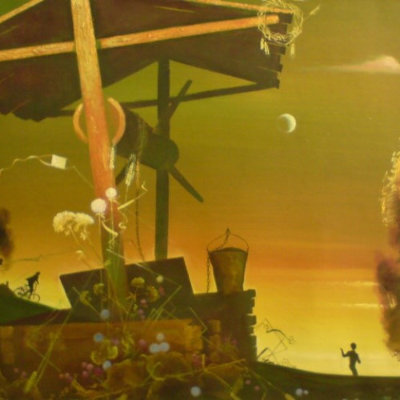
Watercolour painting technique
Ancient China is considered to be the homeland of watercolour, because it was there that paper appeared — so necessary for creating watercolour masterpieces. The first watercolour drawings appeared there too. In Europe watercolour painting was not given proper attention for a long time, and only from the beginning of the 19th century did watercolour take its rightful place in the history of world painting.
The base for watercolour is usually paper, which is often moistened with water beforehand to achieve a particular soft, blurred brushstroke. Working with watercolours outdoors, from nature, requires speed and a well-practised technique. At the same time a vessel with clean water and a sponge should be at hand — the sponge usually takes part in the process on equal terms with the brushes. The brush should be large, number ten to sixteen. The quality of watercolour paper is very important, but the most expensive and best paper is not always available to beginners, so one can perfectly well adapt to the paper at hand.
Modern technique quite successfully uses watercolour pencils, wax crayons and gel inks that appeared on sale relatively recently. The use of these materials should not be intrusive: the more experienced the artist, the less noticeable the use of these novelties.
Watercolour is painting with transparent water paints on paper. Transparency is what should be valued and protected in watercolour.
White paper, reflecting the rays of light through the transparent layers of watercolour paint, gives a special freshness to the shades. You cannot paint on grey or yellow paper. Watercolour paint does not lie well on every kind of paper: the best grades of bleached, grainy paper are needed. Drawing paper with a glossy surface is not suitable — the paint simply runs off it.
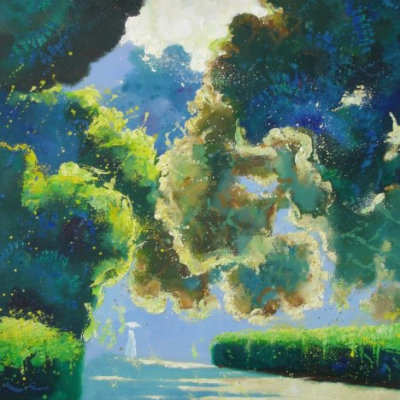
Gouache technique
Gouache is an opaque dense paint consisting of finely ground pigment with a water-glue binder. Gouache paints are produced in two kinds — poster and artistic. Poster gouache is more viscous and has greater covering power and colour saturation. We are interested in artistic gouache: it is the one that can be used to create very beautiful works.
The gouache technique is rather complex and includes various artistic devices. It should be said that working with gouache requires certain skills and a fair amount of patience.
Ways of using gouache:
1. Even filling with a brush — used for colouring surfaces or parts of them. The gouache should not be too thick (the paint will lie in lumps) or too liquid (stains will appear). Filling a contour begins from the edges.
2. Gouache filling with a colour transition — an artistic device often used to create a beautiful background with a smooth tonal transition.
3. Using a ruling pen — with this instrument it is convenient to draw straight and curved lines of a given thickness.
4. «Dry brush» — the device outwardly imitates coloured pencils. Simple to perform, it makes it easy to mix colours directly on the paper.
5. Stamping — applying imprints with a sponge, cotton wool or even a crumpled sheet of paper.
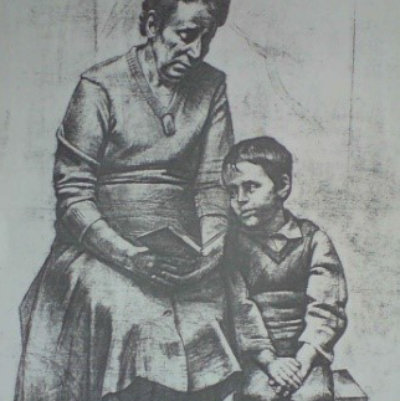
Academic drawing
Most students of painting do not particularly like academic drawing. In essence these are exhausting and difficult exercises in drawing monotonous plaster heads, spheres and cubes from every possible angle. However, there is nothing to be done: these systematic studies, which take almost all free time and energy, are the key to success.
Beginning artists will need the necessary tools: pencils of all possible degrees of hardness, paper of various formats and textures, erasers and other accessories.
The student needs to master the following most important principles of academic drawing:
1) analysis of the construction of an object, 2) the geometrical approach, 3) moving from the simple to the complex, 4) linear perspective, 5) observing proportions, 6) the laws of light and shadow and the construction of composition.
An academic drawing is created with a pencil of a single hardness along the chain «general contour — detailing — generalisation», but paradoxically, at any of these stages the work should look finished. And of course one cannot do without patience and the strictest self-discipline.
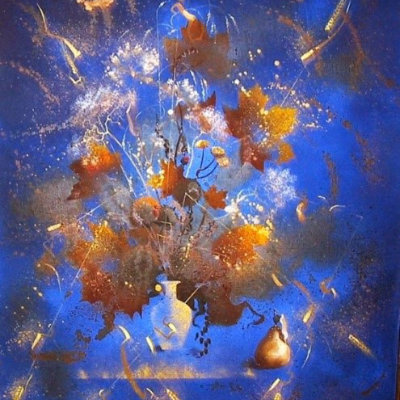
Basics of composition
Any drawing, even the most masterfully executed one, can be ruined by a wrong composition. Composition is not only the ability to arrange objects competently in the plane of the drawing and unite them into a single whole, but also the ability to interest the viewer and attract their gaze to your work. Most often the artist finds the right composition intuitively — it has to be felt — but that does not mean it cannot be learned.
Work on the composition of a drawing must always take into account the peculiarities of human perception. The human eye needs to move across the picture plane. That is why artists create a certain «route» for the eye, similar to simple geometric figures.
As a rule, a drawing has semantic points the eye clings to: first of all the compositional centre attracts attention, then the general space, the perspective, specific details and the background.
There are three basic laws of composition:
1) The law of integrity and indivisibility. Your drawing must be perceived as a whole regardless of the number of objects depicted. The arrangement of the objects is very important here. Each of them makes its own impression, and if they are not ordered, the drawing becomes chaotic and irritating and its overall effect is reduced. All elements should be connected by meaning and spatial arrangement; a composition should be varied but not motley.
2) The law of contrast. Contrast of sizes (small–large), colour contrast, tonal contrast (light–dark), even contrast of meaning. Contrast helps to highlight the main thing and create the general mood of the drawing. If all objects are executed in nuances (the same size, one colour solution, close in tone), the viewer's eye will simply have nothing to cling to and will not see or understand the main point.
3) The law of subordination of all elements and means of composition to a single idea. A composition should always be built around the main object or action. All secondary elements must be subordinate; they should not distract attention or be superfluous. With the help of secondary objects the viewer's gaze should constantly be directed to the main one, leading the eye along a certain route to the semantic centre of the composition.
These are the brief basics of the composition of an academic drawing. These rules can be used in any manner and technique of drawing.